
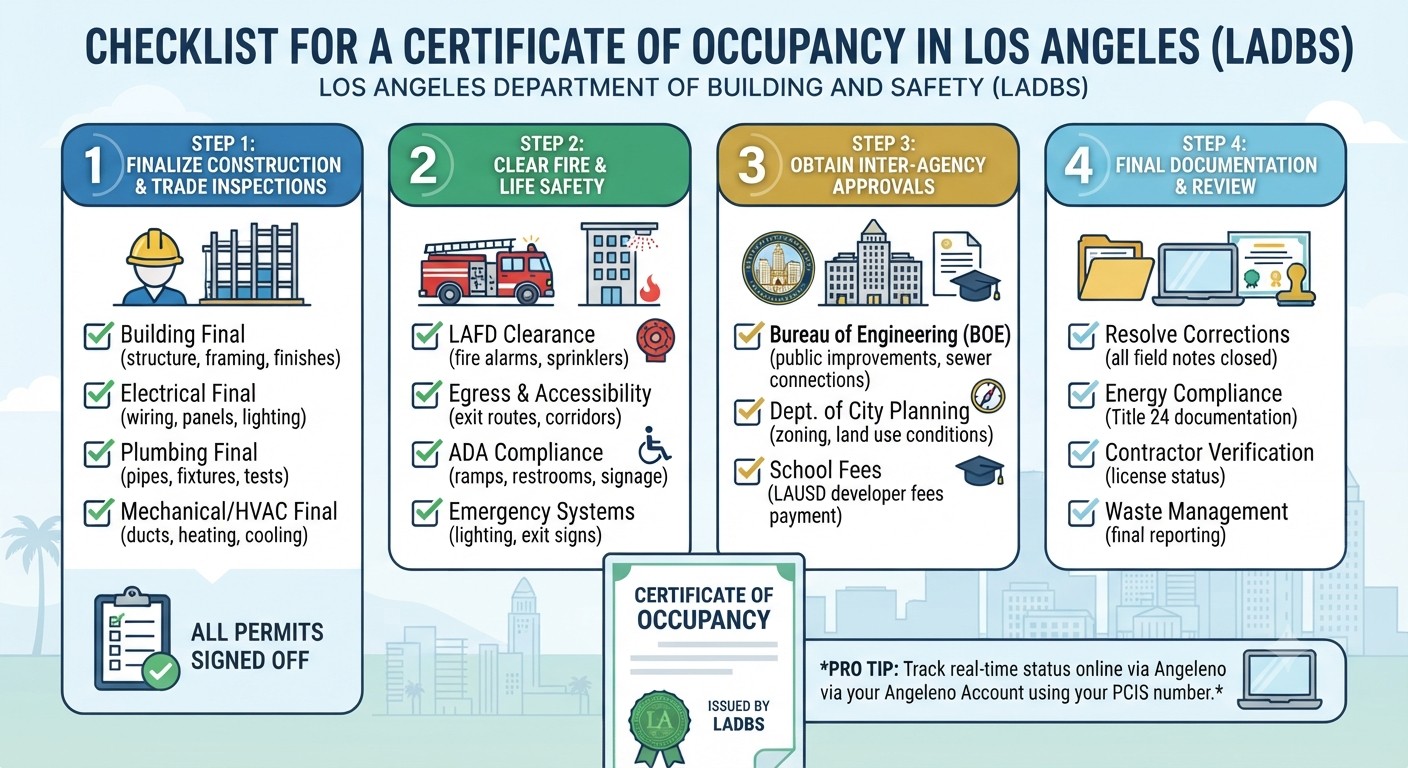

There’s nothing like the sweet relief of getting a construction project completed in Los Angeles. And then, it hits you. You still need to get that Certificate of Occupancy.
Just when you thought you had all the construction done, the city of Los Angeles is there to dot all the i’s and cross all the t’s on their to-do list.
So, what do you have to do to get that Certificate of Occupancy and why is an A-Permit involved?
What is an A-Permit? And Why is it needed for a curb drain?
An A-Permit is the city’s stamp of approval on any project that impinges on the public right-of-way. What is the public right-of-way, you ask? The public right-of-way includes:
- Curb drain
- City streets and lanes
- Alleys
- Parkways
- Sidewalks
- Public easements and unimproved streets
An A-Permit is the city’s way of ensuring that all work done in the public right-of-way is consistent with city code standards. Imagine, if you will, what the city would look like if everyone could construct their sidewalks however they wanted. What if your neighbor decided they just didn’t want to install curb drains? While A-Permits (and the inspections that come with them) may seem cumbersome and time-consuming, they are an important part of the construction process.
What work can be performed with an A-Permit in Los Angeles?
An A-Permit covers construction work completed in the public right-of-way. An A-Permit includes, but is not limited to:
- New driveway installations
- Driveway repair
- Sidewalk installation
- Sidewalk repair
- Curb and gutter repair
- Installation of streetscape fixtures (bicycles racks, speed humps, parklets, parkways landscaping, etc.)
- Street tree wells
- Curb drains
- Street resurfacing/repairs for minor excavations
What is a Public Works Clearance for a Certificate of Occupancy in Los Angeles?
A Public Works Clearance is the city’s final approval on all aspects of your project. You need to get this clearance before you get your Certificate of Occupancy from the Los Angeles Department of Building and Safety (LADBS).
The city’s Bureau of Engineering must review and approve all plans, as well as ensure that all public improvements are completed before you get a Public Works clearance that allows you to then get the Certificate of Occupancy can be issued.
Think of it this way: LADBS regulates what happens inside your property lines, while Public Works regulates how your property connects to the rest of the city.
What work needs to be completed to get my Certificate of Occupancy in Los Angeles?
If you’ve been working with a licensed general contractor on your project, they probably (hopefully?) have been completing all the work required by the city to get you that Certificate of Occupancy.
So, what work needs to be completed to get that Certificate of Occupancy?
Off-Site Improvements
Sidewalks & Driveway Aprons: Upgrades to meet city standards and ADA accessibility rules.
Curbs, Gutters, & Street Paving: Adequate drainage and road restoration where utilities were cut.
Street Trees & Street Lighting: Placement of mandated landscaping or illumination.
Sewer and Utility Hookups
Your site’s sewer lateral connection to the main city sewer line is permitted, properly connected, and compliant.
Stormwater management systems prevent runoff from damaging neighboring properties or city streets.
Dedicated Land and Rights-of-Way
For major developments or commercial projects, you may need to widen the street. That’s right. The city may require you to dedicate a strip of land along the front of your property to widen a street, sidewalk, or alley
Financial and Permit Closure
Before granting the clearance, BOE double-checks that:
All required engineering permits (such as A-Permits for minor street work or B-Permits for major public construction) are officially closed out.
All outstanding public works fees, damage bonds, or construction impact fees have been settled.
How do I clear the pending Public Works that are holding up my Certificate Of Occupancy (CofO) in Los Angeles?
Oof. If you have ever tried to navigate the city’s system of building permits, you know the trials and tribulations of attempting to DIY this process.
Most developers and property owners instead turn to their licensed contractor and a permit expeditor to ensure that all the public works are completed and up to code. A professional permit expeditor has years of experience with the sometimes Kafka-esque process of getting a Certificate of Occupancy. Also, a licensed contractor works with city inspectors to ensure that all the public works clearances are completed and approved.
All of this work requires intense coordination between the permit expeditor, your contractor, city inspectors and the various city offices that issue permits. That’s why it’s best not to handle this process on your own, and hire a professional to take charge.
Ready to get those clearances cleared and get your Certificate of Occupancy? Give us a call today for a free estimate.
Need Help With Your A-Permit Project?
A-Permit.com handles the entire permit process — from application to BOE inspection.